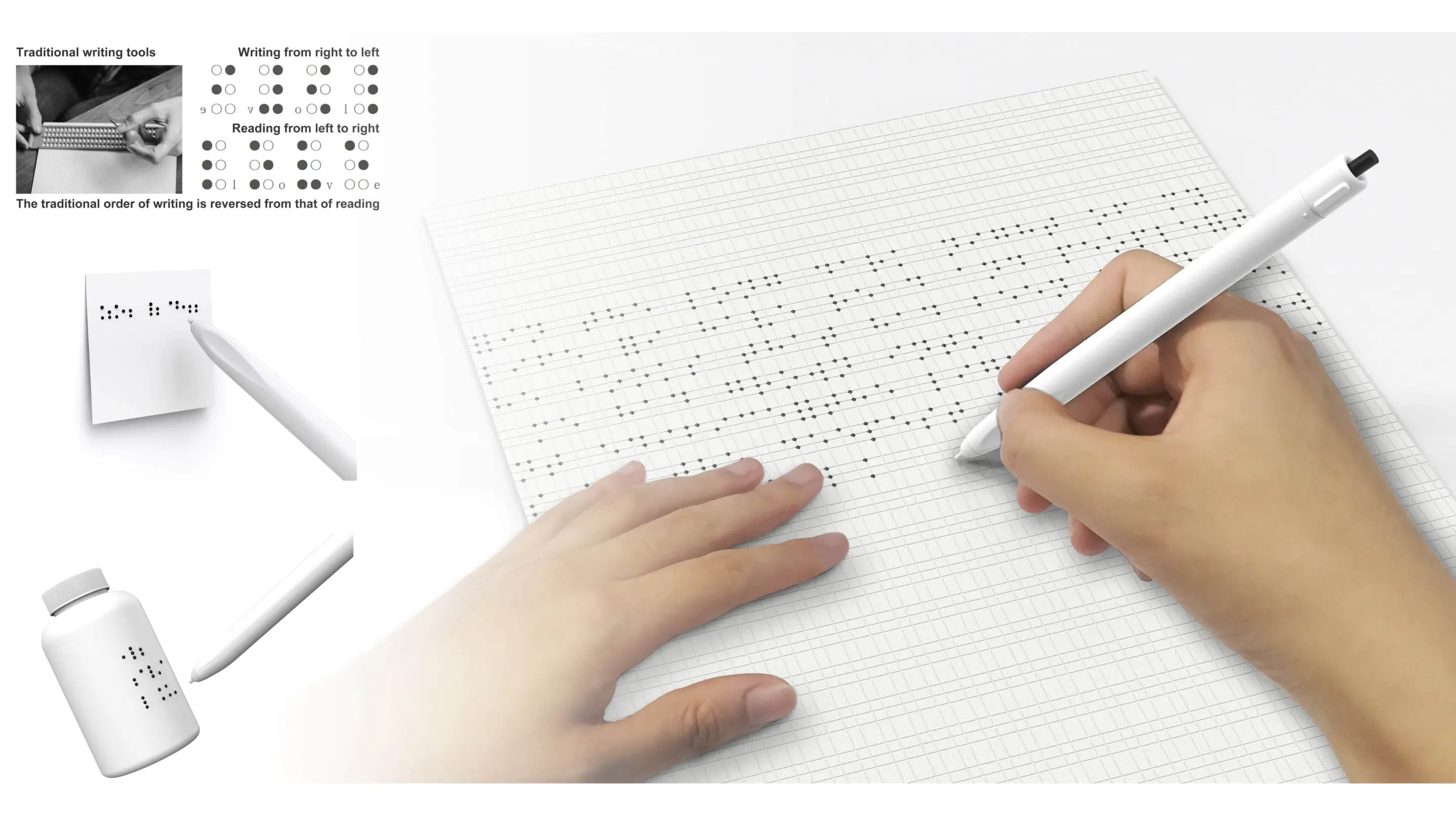
Touchable Pen is a writing instrument designed for the visually impaired. Raised Braille dots are printed when the nib touches any surface. It subverts traditional Braille writing, transforming subtractive manufacturing into additive manufacturing, and reverse writing into forward writing. The Touchable Pen uses low-cost technology to improve both the equity and efficiency of the writing experience for blind people.
Background
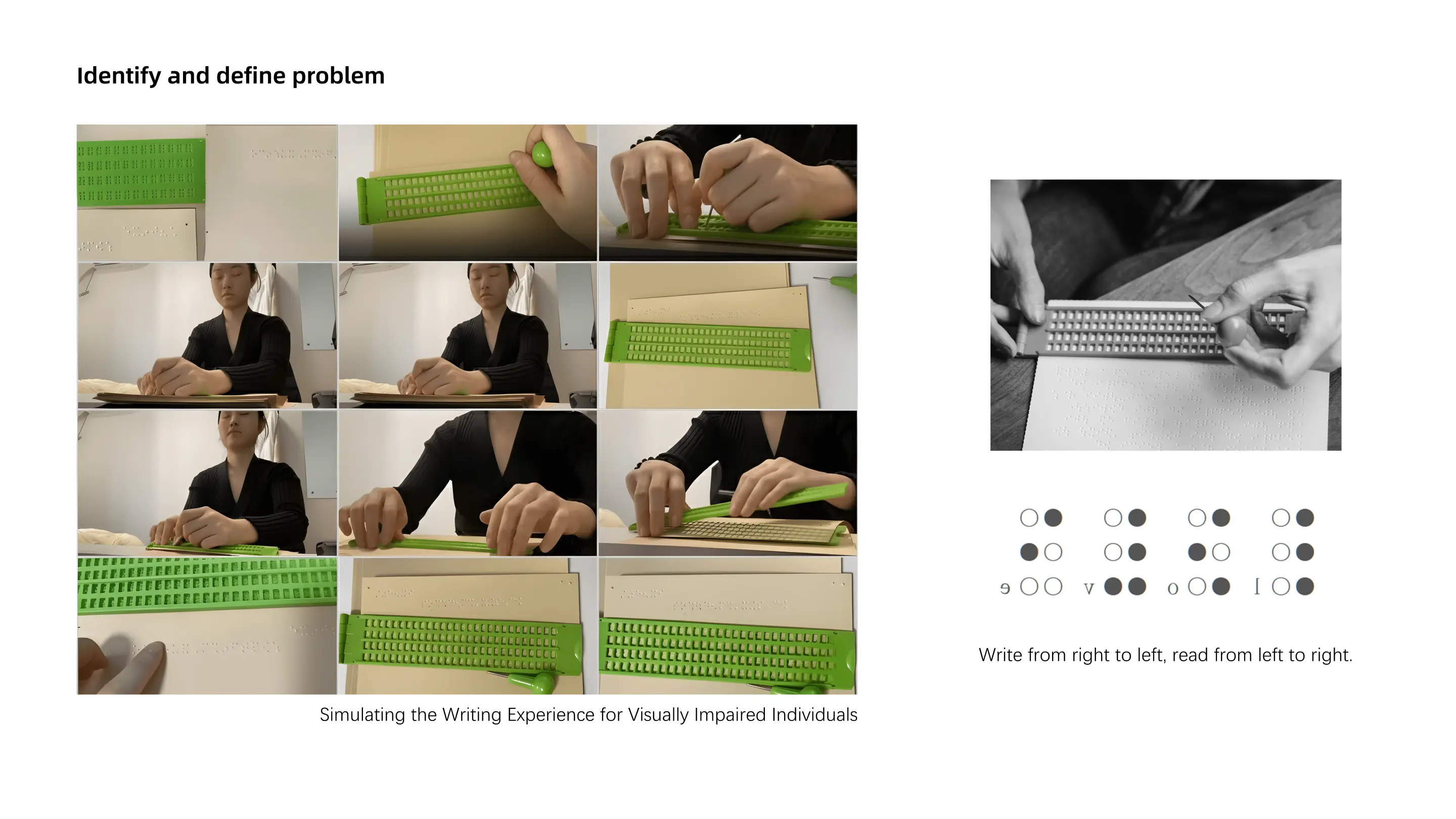
Traditional handwritten Braille usually relies on a slate and stylus. The method is portable and inexpensive, but it asks users to punch dots from the back side of the paper and then read the raised result on the front. In practice, that means the order of writing is reversed from the order of reading: users often write from right to left and read from left to right. For experienced writers this is manageable, but for many everyday note-taking situations it adds cognitive load, slows down writing, and makes immediate checking or correction awkward.
Touchable Pen began with a simple question: what if Braille handwriting could feel more direct and intuitive? Instead of embossing from the back and mentally reversing each character, the project explores a low-cost handheld tool that creates raised Braille dots directly on the writing surface.
Concept
Touchable Pen is a writing instrument for visually impaired users that rethinks Braille handwriting through an additive rather than subtractive logic. Instead of using a stylus to press negative dents through paper, the pen deposits small raised dots on the front side of Braille paper. This transforms the act of writing from mirrored punching into a more immediate dot-building process.
That shift matters for more than convenience. It reduces the gap between writing and reading, makes the logic of character formation easier to understand, and opens the possibility of checking output sooner by touch. In this sense, Touchable Pen is not just a new object, but a reframing of how manual Braille writing can work.
Interaction Logic
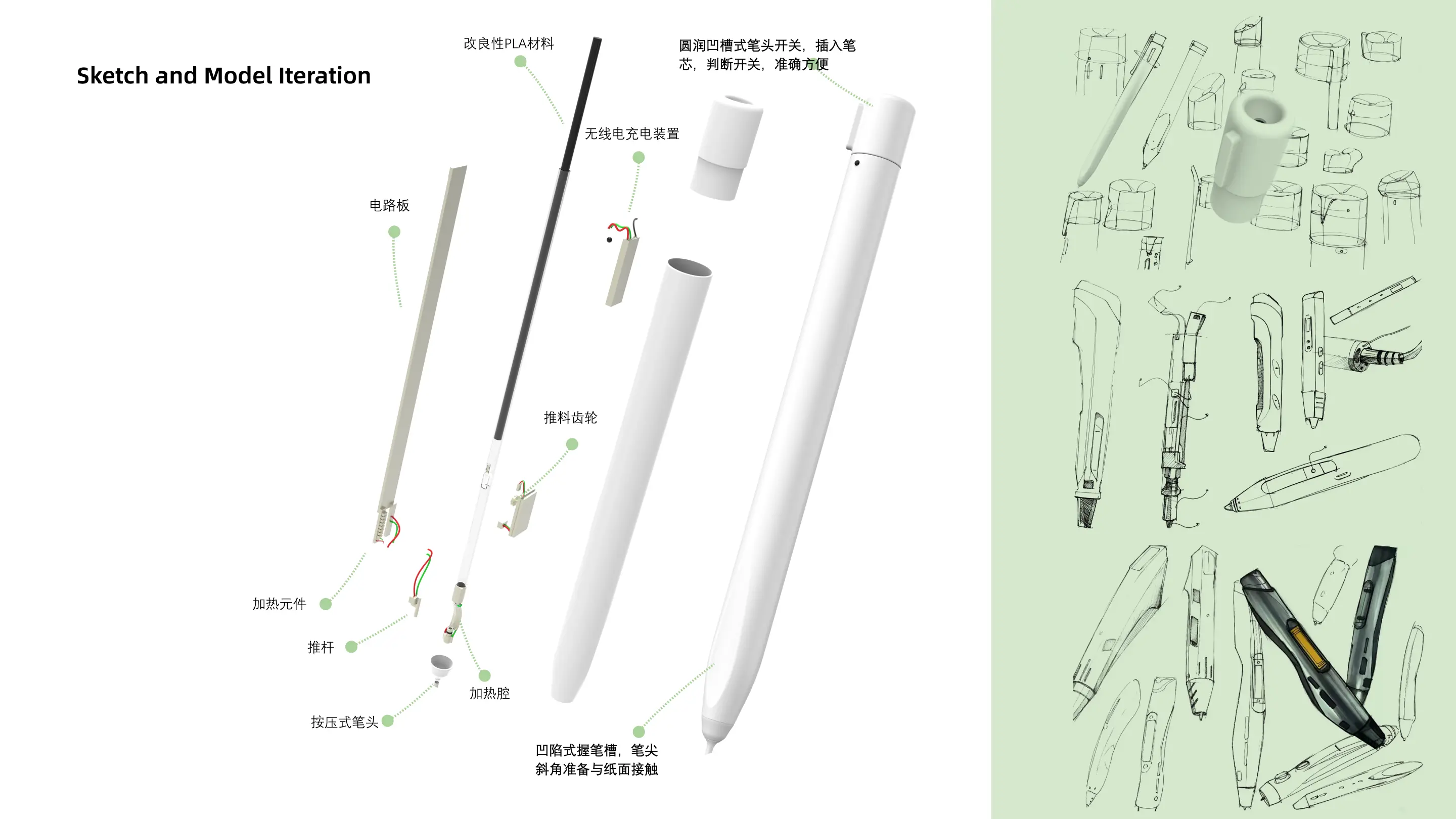
The working principle borrows from the logic of an affordable 3D printing pen and translates it into Braille writing. A modified PLA core is inserted into the pen body and softened through a compact heating mechanism. Once the user positions the nib on Braille paper, a press action triggers the feeding structure. The pen tip retracts slightly, the push rod advances the material, and a controlled amount of softened material exits the outlet. When the nib is lifted, a single raised dot is left on the paper.
The interaction flow is designed to stay simple:
- turn on the pen
- insert the modified material core
- use the non-writing hand to help position on Braille paper
- press to trigger output after confirming the point location
- lift the nib to form one raised Braille dot
- allow quick cooling for immediate touch reading and correction
The diagrams also suggest a practical maintenance logic: when the core is depleted, the pen gives a reminder so the material can be replaced. This keeps the product closer to a familiar writing tool rather than a stationary machine.
Accessibility Opportunity
The key opportunity behind Touchable Pen is that it aligns writing more closely with reading. Traditional slate-and-stylus use requires users to maintain a mental reversal between what they are doing and what they will eventually read. Touchable Pen reduces that burden by letting the tactile result emerge directly on the writing side. It also supports a more continuous loop of positioning, writing, touching, and correcting, which is especially valuable for learning, quick note-taking, or short-form communication.
Rather than treating accessibility as a separate aesthetic category, the project treats it as an interaction problem: how can a writing tool reduce reversal, lower entry barriers, and preserve dignity in the act of writing?
Process
Development
The development started with problem identification rather than form styling. Simulated use of conventional Braille writing tools helped identify where friction appears in practice. That exercise made three issues especially clear: the writing-reading reversal, the constant need for position awareness, and the weak feedback loop during writing.
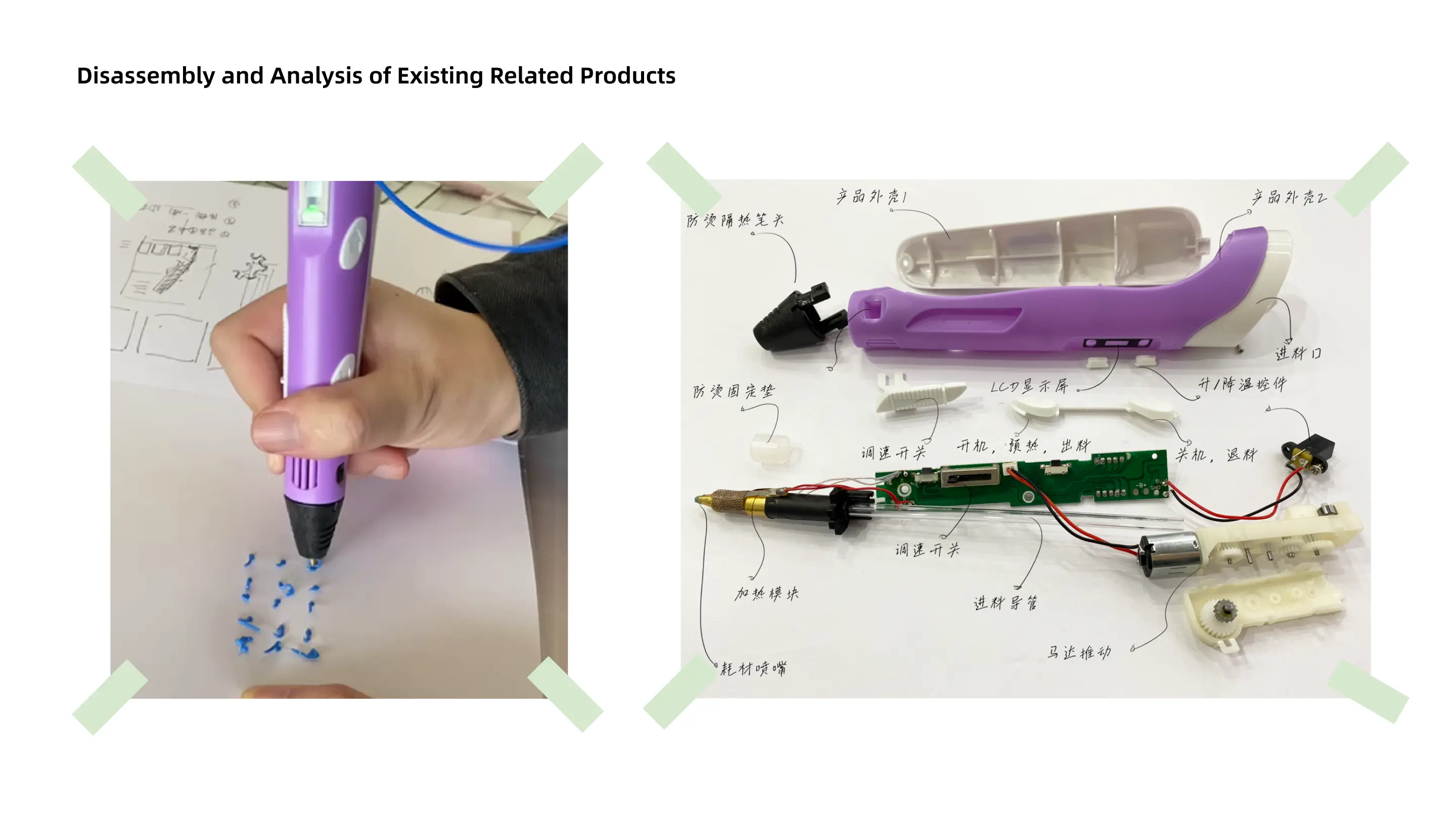
From there, a low-cost 3D printing pen was disassembled to understand how its heating module, feed system, control board, and nozzle could be repurposed for point-based tactile output instead of line drawing. This teardown phase helped turn an abstract idea into a feasible product mechanism.
The later iterations focused on turning that mechanism into a usable writing instrument. The pen body was refined around one-handed holding, while the other hand could assist with positioning on Braille paper. The form explored recessed grip areas, an angled nib that can meet the paper more accurately, and a clearer top-end structure for loading and switching. The result is a concept that combines accessibility thinking, product mechanism, and industrial design language in one compact object.
Why It Matters
Touchable Pen shows how a small change in making logic can reshape an accessibility experience. By shifting Braille handwriting from reverse embossing to direct additive dot formation, the project reduces cognitive reversal, supports quicker checking by touch, and makes note-taking feel more immediate.
The project also demonstrates how an assistive tool can grow from mechanism adaptation rather than feature stacking: starting from a clear interaction barrier, reusing the logic of a compact fabrication device, and turning it into a writing instrument with clearer tactile feedback and a more intuitive workflow.