
Stroke is a severe chronic disease that seriously threatens human health, placing an increasing burden on patients and families. Due to limited rehabilitation medical equipment and therapist, the majority of stroke patients, especially those in the post-acute phase, need long-term self-rehabilitation at home. Traditional homebased rehabilitation training methods are single-minded, providing insufficient sensory stimulation for patients, resulting in unsustainable exercise outcomes. Based on the above, this paper focuses on the design and research of a home-based rehabilitation training system and equipment for lower limb impairment patients, considering two design factors: virtual reality collaborative interaction and multisensory feedback. Firstly, we analyze the rehabilitation movements and rehabilitation needs of lower limb impairment patients. Secondly, we conduct research on the design of a virtual reality collaborative software and hardware rehabilitation interaction system. Thirdly, we complete the design and development of rehabilitation game software based on Unity. Fourthly, we develop rehabilitation wearable hardware equipment that incorporates motion recognition, multisensory feedback, and data synchronization software using sensor technology. The system meets the multi-stage rehabilitation training needs in a home setting. It can be used in conjunction with lower limb rehabilitation exoskeletons during the early stages of rehabilitation and can also be used independently during the middle and late stages of rehabilitation. This enhances the interactive immersion of training, and improves the motivation for rehabilitation.
Background
Lower-limb rehabilitation is one of the most urgent needs for post-stroke patients, yet long-term training is still difficult to sustain outside the hospital. In many home settings, exercises are repetitive, feedback is limited, and motivation drops quickly once therapist supervision is removed. Lower-limb exoskeletons and rehabilitation robots can be effective, but their cost, size, and operational complexity make them difficult to adopt as everyday home tools.
Lower Limb Rehabilitation System explores a lighter alternative: a virtual-real coordinated rehabilitation experience that combines wearable sensing, multisensory feedback, and game-based training. Instead of treating rehabilitation as isolated repetition, the project reframes it as a progressive interactive system in which body movement, virtual guidance, and physical feedback are tightly coupled.
Rehabilitation Framing
The project begins from rehabilitation staging and motion analysis rather than game design alone. Based on common lower-limb rehabilitation practice and Brunnstrom-style recovery logic, the system focuses on the period after static standing balance has been regained and organizes training into three progressive modes:
- dynamic standing balance training
- gait training
- stair-climbing training
This matters because patients at this stage are no longer limited to passive movement, but they still need carefully structured support to improve ankle coordination, hip and knee control, walking stability, and endurance. The project therefore translates clinical rehabilitation exercises into interaction scenarios that patients can repeatedly perform at home with clearer goals and richer feedback.
System Architecture
The system is organized into three coordinated layers.
The first layer is a wearable rehabilitation device with multisensory feedback. It detects lower-limb motion and provides tactile output directly on the body. The second layer is a Unity-based virtual rehabilitation game environment that provides visual task structure, progress guidance, and reward-based motivation. The third layer is the real-time coordination logic between the two: physical movements are sensed and transmitted into the virtual world, while the game evaluates performance and sends feedback commands back to the wearable hardware.
This architecture creates a closed loop of action, interpretation, and response. Instead of simply tracking motion data, the system turns each movement into a perceivable event with consequences in both the virtual and physical layers.
Interaction Design
The project defines a different interaction model for each rehabilitation stage.
In Surfing, which targets dynamic standing balance, the system uses angle-change recognition to train ankle coordination, hip-knee alignment, and torso stability. Smaller and larger resistance settings support different difficulty levels, while correct actions trigger sole vibration, on-screen indication, and audio feedback.
In Walking Adventure, which targets gait training, the system focuses on stepping control and environmental adaptation. Two sub-modes correspond to following footprints and walking on slopes. Distance recognition is used to determine whether the stepping action is appropriate. Correct actions trigger foot vibration, while incorrect actions trigger low-frequency electrical stimulation together with screen and sound prompts.
In Mountain Treasure Hunt, which targets stair-climbing training, the system emphasizes hip and knee flexion-extension ability, walking stability, and endurance. Here, leg-lift height becomes the core input. When the height reaches the target threshold, the device vibrates and the corresponding footprint in the game lights up. When the movement is insufficient but not zero, the user receives low-frequency electrical stimulation and voice prompts. When the foot returns to the ground, the camera advances upward to indicate successful ascent to the next step.
These control rules are important because they do not only say whether a user is “right” or “wrong.” They create a graded feedback structure that distinguishes under-performance, correct execution, and task completion, making the training process easier to understand and more physically engaging.
Game Prototype
The paper presents the stair-climbing mode as a representative implementation through the game Step by Step. The scene was developed in Unity Editor 2019.4.17f1c1 with a first-person perspective, a single-route progression structure, and a treasure-chest reward at the end of the level. The environment uses a low-poly mountain setting with steps, trees, bushes, streams, light mist, and ambient sound to increase immersion without overloading the player.
The game flow also includes lightweight but deliberate interface design. Start, loading, settlement, preparation, pause, and voice-prompt screens support the full rehabilitation session rather than only the in-game moment. Audio feedback is layered across the experience, including environmental sound, footprint cues, encouragement tones, 50% and 80% progress prompts, and end-of-task rewards. A typical stair-climbing session is configured as 50 steps on one side and lasts around 3-5 minutes, which makes the exercise structured enough for repetition while remaining manageable for home use.
Wearable Hardware and Data Flow
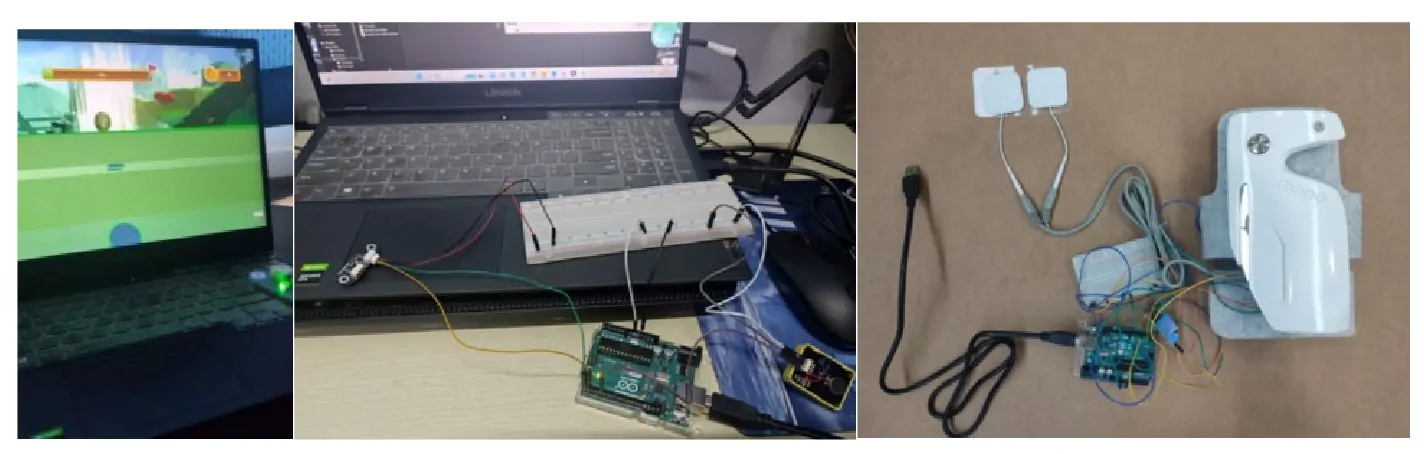
The wearable prototype uses TOFSense laser ranging sensors as the primary input source and combines vibration motor modules with tenS pulse muscle stimulation as tactile output channels. The ranging and vibration modules are connected through Arduino, while the electrical stimulation module communicates through a separate wireless port. All modules are integrated into the hardware enclosure, and the electrodes are mounted on flexible straps so they can contact the user’s skin directly during training.
The data flow is straightforward but meaningful. Sensor data is first configured through NAssistant, then read by Arduino and sent to Unity through the serial port. Unity parses the incoming data, evaluates whether the motion meets the predefined criteria, updates the game state, and sends control signals back to Arduino to trigger vibration or electrical stimulation. In the stair-climbing scenario, this means leg-lift height is not only measured, but immediately translated into feedback that affects both the body and the virtual environment.
From an interaction-design perspective, this is the core value of the system: movement is not merely observed, but turned into a multisensory conversation between patient and device.
Why It Matters
Lower Limb Rehabilitation System shows how home rehabilitation can move beyond repetitive exercise by coupling sensing, virtual tasks, and physical feedback in one continuous loop. Instead of treating wearable hardware and training software as separate tools, the project connects movement recognition, virtual guidance, tactile cues, and progress feedback into a coordinated training experience.
This approach is especially relevant for post-acute home rehabilitation, where patients need structured repetition, clear feedback, and enough engagement to sustain long-term practice outside the clinic.