
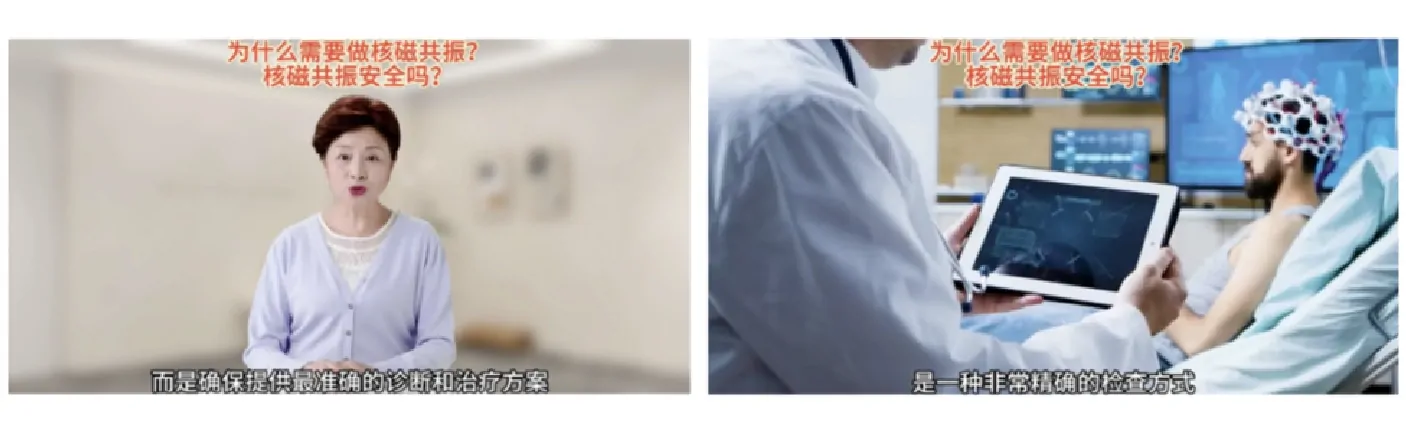
Medical professions' time is invaluable, especially in regions where public medical resources are scarce. They aim to convey substantial content in minimal time to assist a maximum number of patients. However, due to cognitive declines, personal experience, and insufficient medical knowledge, elderly patients often encounter challenges in swiftly comprehending the purpose for medical instructions, especially diagnostic plans. This miscommunication frequently results in feelings of reluctance, frustration, and mistrust towards proposed medical procedures, ultimately impacting the satisfaction of medical communication and execution of treatment plans adversely. In this research, we introduce an innovative approach where the task of explaining medical procedures is entrusted to short-form video generated with Large Language Models (LLMs). Based on preliminary data on patient preferences and medical history, LLM is applied in generating personalized explanatory video, featuring virtual representations of a doctor. The generation strictly follows a procedure of persona modeling, target generation, script generation, and video generation. With a N=20 study involving a simulated scenario where physicians suggest an MRI scan - a costly and sometimes unfamiliar procedure for many elderly patients - the proposed method show an obvious decline in the patient鈥檚 negative experience, including reluctance, frustration, and mistrust. This study pioneers the integration of Large Language Models in crafting personalized explanatory videos for elderly patients, enhancing medical comprehension and experience. Our method presents a novel convergence of Meta Human, NLP technology, and elderly鈥檚 patient-centered care, bridging communication gaps in healthcare scenarios.
Background
Medical communication becomes especially fragile when time is short, the topic is technical, and the patient is elderly. Older adults often need to make decisions about procedures that are costly, unfamiliar, or easy to misunderstand, but they may process new information more slowly, rely heavily on prior experience, and bring strong expectations about what trustworthy medical advice should look like. When the explanation is not understood, the result is not only confusion but also reluctance, frustration, and mistrust toward the recommendation itself.
This project, abbreviated here as EMCI, explores whether personalized short-form videos generated with large language models can reduce that gap. Instead of asking physicians to manually prepare a separate explanation for every patient, the project proposes a structured AI-assisted workflow that turns patient characteristics, trust preferences, and topic-specific concerns into customized explanatory content.
Problem Framing
The work starts from a healthcare communication problem rather than a media-generation problem. In hospital settings, medical staff often need to explain complex instructions quickly, but elderly patients may struggle to absorb unfamiliar concepts under stress. Diagnostic procedures such as MRI are a good example: many older adults know little about how MRI works, may confuse it with CT or radiation-based scans, and may therefore perceive it as unnecessary, risky, or financially burdensome.
From a design perspective, the challenge is not simply “how to generate a video.” It is how to generate an explanation that feels understandable, relevant, and trustworthy to a specific elderly patient without requiring excessive manual labor from the healthcare side.
Method Overview
The paper proposes a four-step workflow:
persona modelingtarget generationscript generationvideo generation
In the first stage, the system collects four categories of information: person-related information, trust-related information, topic-related information, and short-form video preferences. These inputs help shape both what should be explained and how it should be explained. The goal is to make the generated video align with the elderly user’s level of understanding, preferred communication form, and trusted source cues.
In the second stage, the workflow generates two outputs: a narrator persona and a set of key considerations. The narrator can be modeled to feel closer to the patient’s trust expectations, while the key considerations identify what the patient may misunderstand, fear, or resist about the medical recommendation.
Script and Video Pipeline
The script-generation stage is designed to reduce hallucination risk and improve structure. Instead of prompting the model once for a full answer, the process first retrieves reference medical material, then generates the video in a top-down way through four parts:
- introduction
- educational content
- trust-building elements
- call to action
Each section is then expanded into a more detailed breakdown, including narration and scene descriptions. This creates a bridge between language generation and actual video production.
For the final experiment, the team manually completed the last production stage because available video-generation APIs were still limited. Narration was synthesized through iFlyTek AIGC Content Creation Platform, virtual-avatar and stock-scene elements were assembled according to the generated breakdown, and the final video was edited in CapCut. This detail is important because the project is not presented as a fully automated end-product, but as a credible research workflow that points toward future automation.
Study Design
The evaluation focused on one simulated scenario: an elderly patient with a persistent headache is advised by a doctor in a public hospital in China to undergo an MRI examination. This scenario was chosen because MRI is plausible for the target population, not well understood by many participants, and often associated with misconceptions about risk.
The study recruited 20 Chinese older adults (7 men, 13 women, mean age 54). All participants reported liking short-form videos, and 42.8% had previous experience obtaining medical information through that format. After questionnaires were used to gather personalization inputs, participants were grouped, and customized videos were generated during a 48-hour interval before the second session.
The evaluation combined:
- pre- and post-video questionnaires
- adapted scales for reluctance, frustration, and medical mistrust
- semi-structured interviews
This mixed-method design makes the project more than a speculative AI concept. It tests whether personalized explanation actually changes the emotional and cognitive experience around a medical recommendation.
Findings
The quantitative results were encouraging. After participants watched the personalized video, reluctance decreased with p=.01, d=0.64, frustration decreased with p=.025, d=0.76, and mistrust decreased with p=.002, d=0.97. Together, these results suggest that personalized LLM-assisted explanatory videos can meaningfully improve how elderly patients experience difficult medical advice.
The qualitative findings also added nuance. Many participants reported better understanding of MRI after watching the video and felt more confident about the doctor’s decision. Some said the content helped them understand why the test was necessary, while others focused more on learning that the procedure was safe. Preferences were mixed in a useful way: 25% highlighted ease of understanding, 15% responded positively to the virtual-avatar presentation, and 35% mainly valued the content itself. At the same time, 20% disliked the speech speed, and 25% still preferred direct explanation from a physician.
That tension is one of the most important design takeaways. Personalized video can support trust, but it does not replace the physician-patient relationship for everyone.
Design Implications
EMCI shows that AI-generated content can be valuable when it is framed as supplemental medical explanation rather than a wholesale substitute for clinicians. The project suggests a practical future direction for healthcare communication tools: doctors or hospitals could collect a lightweight set of personalization inputs, automatically generate a short explanatory video, and deliver it after consultation to reinforce understanding, reduce anxiety, and improve trust.
At the same time, the work also surfaces important limitations. The study used one simplified scenario, the final video-production process still required manual intervention, and the method currently depends on collecting a relatively large amount of personal information, which raises privacy concerns. These limits are part of the value of the project: it does not only present an optimistic AI vision, but also identifies what must be improved before such a system can be responsibly used in real clinical contexts.
Why It Matters
EMCI shows that AI-generated short-form video can work as a supplemental explanation layer in healthcare when it is grounded in patient-specific context rather than generic script generation. By combining persona modeling, trust cues, structured scripting, and lightweight video production, the project turns LLM output into a communication workflow that is easier to understand, personalize, and evaluate.
The project also points toward a practical direction for elderly-friendly medical communication: not replacing doctors, but extending consultations with explanations that patients can revisit after the appointment.